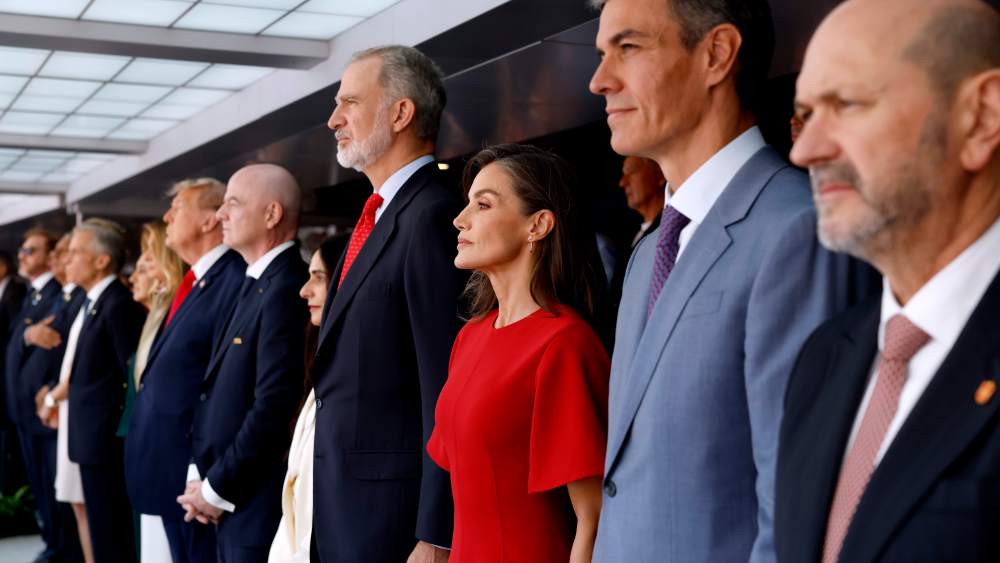
Queen Letizia wore a red dress to match Spain’s uniforms and cheer on the team at the World Cup Finals in East Rutherford, N.J. Sunday.
In a strong show of support, the Spanish royal traveled to the game with King Felipe VI and Princesses Leonor and Infanta Sofia.
King Felipe VI sported a red necktie with his dark suit, a more subtle nod to the team. The couple’s elder daughter paired a white cinched shirt with red pants and their other daughter Infanta Sofia donned a red shirt with khaki pants.
This week, a behind-the-scenes video of the family’s fandom was posted on Instagram. The foursome was seated arm in arm, wearing replica jerseys of Spain’s team and celebrating the country’s dramatic semifinal win over France. Their jerseys, numbered 26, represented this year’s World Cup.
While King Felipe is considered to be one of the best-dressed statesman, Queen Letizia, a former journalist, and her daughters are fashion forces in their own right.
The queen’s latest looks have included pieces from Carolina Herrera, Mango, Byan Basalt and Adrianna Papell, among others.
Leonor, 20, has turned up at recent appearances wearing pieces from CH Carolina Herrera, Moliane Lamia, and Bleis Madrid. In her role as Spain’s heir presumptive, the princess just wrapped up three years of army, naval and air force training. In September, she will start studying political science at Carlos III University of Madrid.
Meanwhile, 19-year-old Infanta Sofia, Leonor’s younger sister, is carving out a fashion following of her own. She has been sporting labels like Mango, Momoni, Sézane, Claudie Pierlot and Mirto.
PakarPBN
A Private Blog Network (PBN) is a collection of websites that are controlled by a single individual or organization and used primarily to build backlinks to a “money site” in order to influence its ranking in search engines such as Google. The core idea behind a PBN is based on the importance of backlinks in Google’s ranking algorithm. Since Google views backlinks as signals of authority and trust, some website owners attempt to artificially create these signals through a controlled network of sites.
In a typical PBN setup, the owner acquires expired or aged domains that already have existing authority, backlinks, and history. These domains are rebuilt with new content and hosted separately, often using different IP addresses, hosting providers, themes, and ownership details to make them appear unrelated. Within the content published on these sites, links are strategically placed that point to the main website the owner wants to rank higher. By doing this, the owner attempts to pass link equity (also known as “link juice”) from the PBN sites to the target website.
The purpose of a PBN is to give the impression that the target website is naturally earning links from multiple independent sources. If done effectively, this can temporarily improve keyword rankings, increase organic visibility, and drive more traffic from search results.