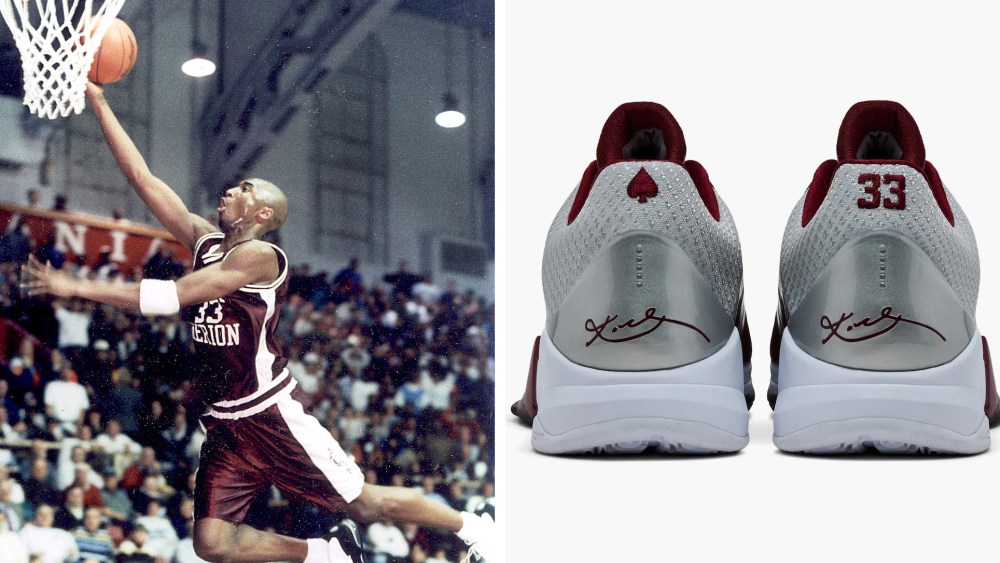
Back in 2010, Nike made two versions of Kobe Bryant‘s then-current signature sneaker modeled after the home and away uniforms of his high school basketball team. One of those is now coming back.
The Nike Kobe 5 Protro “Lower Marion Aces” sees the colorway reprised with modernized tech for the first time. Metallic silver serves as the base, while maroon carries over from the overlays to the forefoot of the midsole and outsole. The rest of the sole unit is rendered in white, and maroon rears its head again for the lining and brand elements, which include a new ace graphic and Bryant’s high school number 33 on the left and right heel, respectively.
Just like the launch of the new Kobe 1 Protro “City of Champions,” the Kobe 5 Protro will release alongside an Air Force 1 Low with complementary treatment. Two colorways are expected this time, with the addition of two more Dunk Lows as well.
Nike has brought the Lower Marion look to several Nike Kobe sneakers over the years, beginning with the Kobe 3 in 2008. The 2010 Kobe 5 release came as a part of a series that included two colorways for Rice High School, a Harlem catholic school that was sponsored by Bryant at the time.
A similar look appears on Caitlin Clark’s Kobe 5 Protro “Rookie of the Year,” which will release this spring with a mix of red and silver nodding to Indiana Fever’s red jerseys and the silver trophy she was awarded.
The Nike Kobe 5 Protro “Lower Merion Aces” will release March 23 through the Snkrs app and select third-party retailers. Pricing is set at $200.
Nike Kobe 5 Protro “Lower Merion Aces” (pair)

Nike Kobe 5 Protro “Lower Merion Aces” (lateral)
Nike Kobe 5 Protro “Lower Merion Aces” (medial)
Nike Kobe 5 Protro “Lower Merion Aces” (heel)
Nike Kobe 5 Protro “Lower Merion Aces” (outsole)
PakarPBN
A Private Blog Network (PBN) is a collection of websites that are controlled by a single individual or organization and used primarily to build backlinks to a “money site” in order to influence its ranking in search engines such as Google. The core idea behind a PBN is based on the importance of backlinks in Google’s ranking algorithm. Since Google views backlinks as signals of authority and trust, some website owners attempt to artificially create these signals through a controlled network of sites.
In a typical PBN setup, the owner acquires expired or aged domains that already have existing authority, backlinks, and history. These domains are rebuilt with new content and hosted separately, often using different IP addresses, hosting providers, themes, and ownership details to make them appear unrelated. Within the content published on these sites, links are strategically placed that point to the main website the owner wants to rank higher. By doing this, the owner attempts to pass link equity (also known as “link juice”) from the PBN sites to the target website.
The purpose of a PBN is to give the impression that the target website is naturally earning links from multiple independent sources. If done effectively, this can temporarily improve keyword rankings, increase organic visibility, and drive more traffic from search results.